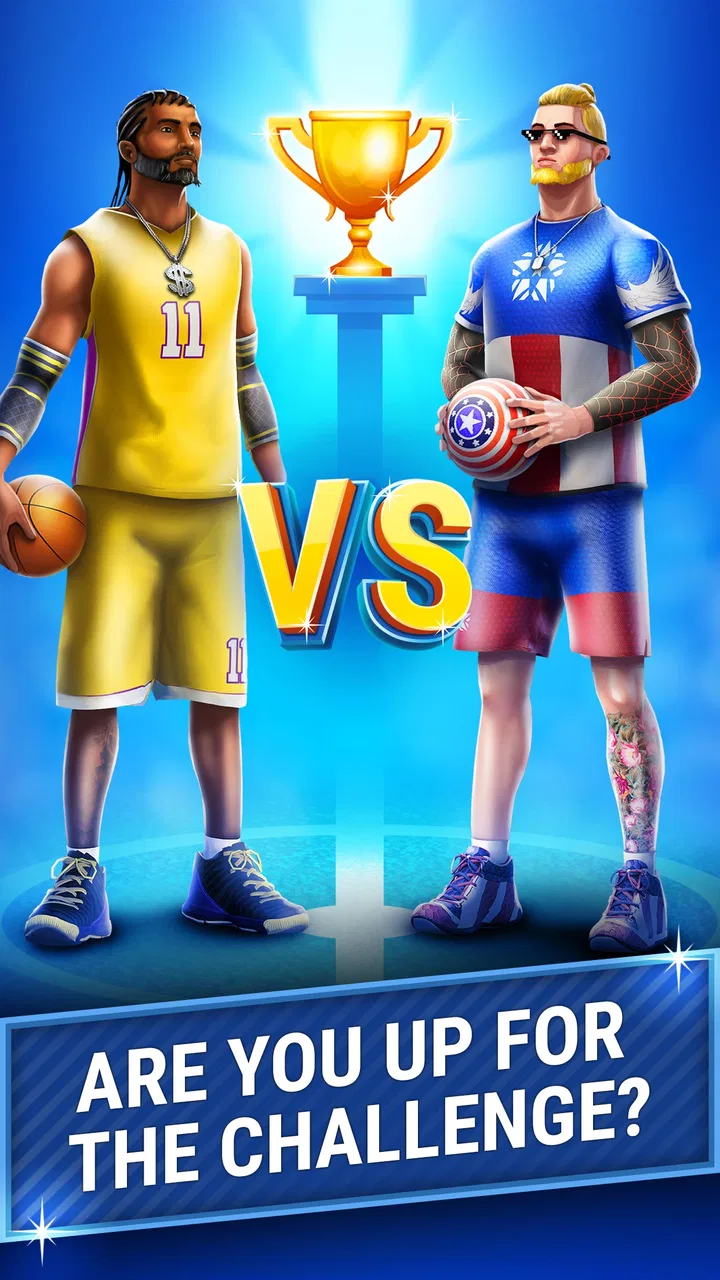
3pt Contest: Basketball Games
- 4.4
- Rating
- 5.00M
- Installs
- Free
- Price

 Analysis by App-foxy
I found 3pt Contest: Basketball Games easy to understand within a few minutes, but its appeal depends heavily on what I want from a sports game. This is a focused basketball shooting game from Webelinx Games, built around three-point contests rather than full matches, team management, or a long career simulation. I can open it, take shots, and work through its challenges without learning a large rule set first. That simplicity is its strongest quality, especially when I want a short break instead of a demanding game session.
At the same time, the compact design creates clear limits. I am not getting a complete basketball experience with passing, defense, substitutions, or a detailed league structure. The game stays close to its central idea: line up shots, improve my timing, and move through levels and missions. For players who enjoy repeating a small action until it feels more consistent, that can be satisfying. For anyone looking for a broad sports simulation, it may feel narrow quite quickly.
How the game works for different players and situations
I find this game works best when I treat it as a small, focused shooting challenge rather than a substitute for a full basketball match. Its limited scope makes it easy to fit into a spare moment, but the most satisfying sessions come when I can give the shot my attention instead of tapping through while distracted. That distinction helps explain which players and everyday situations suit it—and where its simple format can start to feel restrictive.
You May Also Like

 Google Keep - Notes and lists
Google Keep’s Quiet Growth Shows the Appeal of Simpler Notes
As mobile work gets busier, Google Keep keeps winning a simple contest: capture a thought quickly, find it later, and get on with the day.

 Blood Strike: 2.5 Anniversary
Blood Strike’s Loadouts Turn Every Drop Into a Tactical Gamble
A close look at Blood Strike’s custom loadouts: how fast access to signature weapons reshapes its battle royale rhythm, rewards preparation, and narrows the gap between fights.

 Pandora - Music & Podcasts
Pandora’s Music Is Easy to Start, but Harder to Recover
Pandora’s strength is its low-effort path from a seed to a station. Its weak spot is how much confidence it asks you to place in connection, setup, and quiet recovery.

 8 Ball Pool
 Is Built on Rivalries, Rematches, and Routine
A close look at the rivalries, rematches, shared routines, and unanswered safety questions that turn a quick pool match into a persistent mobile community.

 Samsung Music
’s Quiet Strength Is Playing What You Already Own
Its reach comes less from spectacle than from dependable access to a personal library. That simplicity is both the app’s strongest retention engine and its ceiling.

 AccuWeather: Weather Radar
AccuWeather Review: A Quick, Clear Forecast for Everyday Decisions
For everyday plans, the best forecast is the one you can understand quickly. AccuWeather makes rain timing, radar, and local conditions easy to act on, with a few trade-offs.
More From Our News Desk



Readable goals and straightforward navigation
The first thing I appreciate is that the game communicates its purpose clearly. The short description, “3pt Contest,” is accurate in spirit: I am here to shoot from beyond the arc, not manage an entire basketball roster. The store summary also points to levels and missions, and those objectives give the basic shooting loop more direction than an endless practice mode would have on its own.
That focused structure helps with readability and navigation. I do not need to remember a complicated control scheme before playing. The main decisions are connected to the shot itself and to the current challenge. When a game presents one central action instead of several overlapping systems, it is easier for me to return after a few days away without feeling lost.
This is particularly useful for younger players and for people who do not normally play sports titles. The content rating is Everyone, which fits the accessible premise and family-friendly presentation. I would still guide a child through the first session so they understand how the menus, missions, and any purchase prompts work, but the basketball concept does not require specialist knowledge.
The levels and missions also provide a practical way to set small goals. Rather than deciding that I must play for a long period, I can approach one challenge at a time. That matters for players who prefer short, clearly bounded activities. It also makes the game more suitable for a quick commute, a waiting room, or a few minutes between other tasks, provided the playing environment is comfortable enough for touch controls.
One useful habit is to treat each mission as a test of consistency rather than simply chasing a high score. I pay attention to whether I am missing because of poor timing, rushing, or a difficult position. This turns a simple contest into a small practice routine. The game does not need a complex tutorial to support that approach; the limited scope makes it possible to learn by repeating the same kind of action.
There is a trade-off here. A clean interface can reduce confusion, but it can also make progress feel less varied. If I prefer menus full of statistics, player customization, or strategic choices, this will not offer the same depth as a full basketball game. Its clarity comes partly from leaving out systems that would appeal to a different audience.
Touch control, vision, and physical comfort
The most important accessibility question for me is whether I can perform the shooting action comfortably and consistently. A game based on repeated touch interaction may suit players who are comfortable with precise gestures, but it can be less welcoming for anyone with limited dexterity, hand tremors, joint pain, or difficulty maintaining a steady movement. I would not assume that a simple control is automatically an easy control.
For players with reduced vision, the practical experience will depend on how clearly the court, ball, aiming cues, and interface elements appear on their particular screen. I found that a larger display can make the shooting area easier to follow than a small phone, while a bright or crowded environment can make visual timing more tiring. Playing with the screen at a comfortable distance and cleaning the display can make a surprisingly noticeable difference.
Because the core action is visual, I would be cautious about recommending it to someone who needs strong audio guidance or nonvisual controls. The game’s appeal is tied to seeing the shot setup and responding at the right moment. A player who cannot comfortably track those elements may find that the central mechanic, rather than the menus, is the main barrier.
Players with hearing differences may have an easier time if they can follow the visual action without relying on sound, but I would not present that as a guarantee for every device or situation. The safest way to judge it is to try a short session with audio turned down and see whether the visual feedback remains understandable. That test also helps anyone playing in a quiet place, at work, or beside someone who is sleeping.
For motor comfort, I recommend holding the phone in a stable position instead of trying to play one-handed while walking. A table or relaxed two-handed grip can reduce accidental touches and make repeated attempts less tiring. This is not a special feature of the game, but it is a realistic way to make a touch-based shooting contest more manageable.
Another useful approach is to stop treating every miss as a reason to speed up. When I rush because I want to complete a mission, my hand movement becomes less controlled and the game feels more frustrating. Short pauses between attempts help me distinguish a genuine difficulty in the challenge from fatigue in my hands or eyes. That distinction is important for anyone who may need more recovery time during repeated actions.
Playing in short sessions and changing environments
One of the strongest use cases is the small gap in an ordinary day. I can imagine opening the game while waiting for an appointment, playing a few attempts, and closing it without needing to remember a complicated story or restore a long match. The levels and missions give those short visits a purpose, while the three-point focus keeps the session easy to understand.
However, the same design can be awkward when my attention is divided. If I am on public transport, surrounded by movement, or frequently interrupted, precise shooting becomes less comfortable. A missed attempt in that setting may say more about the environment than my skill. I would use it in a stable seat rather than while walking, and I would avoid playing near roads or in any situation where the screen could distract me from what is happening around me.
It also works as a low-pressure introduction to basketball games. Someone who finds full sports simulations overwhelming can start with a single skill. The game does not ask me to understand team tactics before I can enjoy it. That makes it a reasonable choice for casual players, children who like basketball imagery, and adults who want a quick skill-based distraction rather than a serious simulation.
On the other hand, players who need offline certainty, extensive control customization, or a deep competitive environment should examine their expectations before installing it. I would not choose this as my only basketball game if I wanted realistic seasons, detailed rosters, or the feeling of controlling an entire team. A full basketball simulator is the better alternative for those goals, even if it takes longer to learn and demands more attention.
The game is free to download, which lowers the barrier to trying it. There are in-app purchases ranging from $0.99 to $129.99 per item, so I would keep purchase controls in mind when sharing a device with a child or when I am trying to keep the experience completely free. The free entry is useful, but it does not mean every part of the surrounding purchase experience will suit every household.
My practical advice is to decide on a personal rule before starting: either ignore optional purchases or set a clear spending limit. That helps keep the focus on improving shots and completing missions instead of making an impulse decision after a frustrating attempt. For families, checking device-level purchase protections is sensible even with an Everyone-rated game.
Where the inclusive experience still has friction
The biggest remaining barrier is the dependence on precise visual interaction. A game can be simple in concept and still be demanding for players who need larger targets, slower timing, alternative input methods, or stronger contrast. I would not assume that the absence of complicated controls means the game accommodates every ability level.
Repetition is another mixed point. Repeating shots can help me learn the rhythm, but it can also become tiring for players with limited stamina, attention differences, or discomfort from sustained hand movement. The mission structure gives repetition a reason, yet it does not remove the physical or sensory cost of doing the same kind of action many times.
The narrow basketball format may also affect cognitive accessibility in two opposite ways. It reduces the number of rules I need to track, which is helpful, but progress can become less motivating if I need more variety to stay engaged. A player who benefits from predictable routines may enjoy the consistent loop. Someone who needs frequent changes in task type may prefer a more varied sports game.
Screen size and device setup matter more here than they might in a menu-heavy app. A phone with a cramped display can make visual details harder to follow, while a larger screen may provide more comfortable spacing. I would test the game on the device I intend to use rather than relying on how it feels on someone else’s phone. This is especially relevant for older players or anyone who already enlarges text and interface elements elsewhere.
There is also a social consideration. A player who enjoys competing with friends may get more value from a multiplayer sports title or a game with a stronger shared league structure. This contest is better suited to personal practice and individual progress. I can hand the phone to someone else for a turn, but that is different from having a full social basketball experience built around cooperation or team play.
The current version is 5.5.0, and the game supports devices running Android 7.0 or later. That makes the compatibility range useful for people who keep an older phone, although the actual comfort of play will still depend on the screen and touch response of that device. I would check the operating system before planning to install it on an older handset, especially if it is being used by a child or a family member who cannot easily troubleshoot compatibility issues.
Who should choose it, and who should skip it
I would recommend it to someone who wants a free sports game with an immediately understandable premise, short sessions, and goals that encourage repeated practice. It is a good fit when I want to focus on one basketball skill without dealing with team lineups, defensive controls, or a long season. The game’s broad reach is reflected in its average rating of 4.4 from around 27 thousand ratings, and more than 5 million installs show that the format has found a substantial casual audience.
I would also suggest it for a player who likes gradual challenges more than open-ended practice. The missions give me a reason to return, and the levels help organize the experience. My advice is to play with a relaxed grip, use a stable surface when possible, and judge difficulty over several attempts rather than after one bad round. Those small changes make the game feel more like a skill exercise and less like a test of patience.
I would skip it if my priority is realistic basketball strategy, full matches, online team competition, or extensive accessibility controls. A full basketball simulation will be more appropriate for someone who wants passing, defense, and roster decisions. A slower puzzle or turn-based sports game may be better for players who cannot comfortably perform repeated timed touch actions.
I would also hesitate to choose it for someone who becomes frustrated by repetition or who needs the game to provide a wide range of tasks. The focused design is exactly why it is approachable, but that focus can become monotonous. The right question is not whether it contains enough basketball in general; it is whether a three-point shooting loop is the kind of activity the player actually enjoys repeating.
My overall recommendation
After spending time with it, I see this as a compact basketball shooting game rather than a miniature version of a full sports simulator. That distinction matters. Its best qualities are the clear premise, quick entry, mission-based structure, and suitability for short personal sessions. I can recommend it to casual players who want a simple way to practice timing and chase small goals.
Its inclusive appeal is real but limited. The Everyone rating and uncomplicated concept make it approachable, yet the actual shooting interaction still favors players who can see the action clearly and perform repeated touch movements with reasonable precision. I would frame it as easy to understand, but not automatically easy for every body or every environment.
Webelinx Games has kept the experience focused enough for a quick break, and that focus is more valuable than a long list of systems would be in this particular format. Still, I would try it first on the intended device, pay attention to hand and eye comfort, and decide whether the purchase setup fits the household. With those expectations in place, 3pt Contest: Basketball Games is a worthwhile free choice for casual basketball fans who enjoy repetition, visible progress, and short challenges. It is not the right pick for deep simulation or players who need highly adaptable controls, but within its narrow lane, it delivers a straightforward and approachable shooting experience.
FAQs for 3pt Contest: Basketball Games
01What is 3pt Contest: Basketball Games?
3pt Contest: Basketball Games is a mobile app available for both Android and iOS that allows players to engage in virtual basketball shooting competitions. The game focuses on the three-point shot, offering a variety of challenges and levels to enhance shooting skills and compete with other players globally.
02What are the main features of 3pt Contest: Basketball Games?
The app features multiple game modes, including timed challenges and practice sessions. It offers realistic graphics and physics, leaderboards to compete with friends and players worldwide, and customizable player avatars. Users can also unlock different basketball courts and balls as they progress through the game.
03Is 3pt Contest: Basketball Games free to download and play?
The app is free to download and play with optional in-app purchases. These purchases may include items like special basketball skins, exclusive courts, and other enhancements that can improve the gaming experience. However, all levels and features can generally be accessed without spending money.
04Does 3pt Contest: Basketball Games require an internet connection?
An internet connection is necessary for certain features such as leaderboards and online multiplayer competitions. However, the game can also be enjoyed offline in single-player mode, allowing users to practice and enhance their skills without an internet connection.
05How does 3pt Contest: Basketball Games ensure fair competition?
The app uses an advanced matchmaking system to pair players of similar skill levels in competitive modes. Anti-cheat technologies are in place to maintain fair play, and regular updates are provided to patch any vulnerabilities. Player feedback is actively monitored to ensure a balanced and enjoyable gaming environment.
Pros
- Engaging gameplay with realistic physics.
- Variety of game modes keeps it fresh.
- User-friendly interface and controls.
- Regular updates enhance features.
- Great graphics for an immersive experience.
Cons
- In-app purchases can be pricey.
- Requires stable internet connection.
- Occasional lag on older devices.
- Ads can be intrusive during gameplay.
- Limited offline features.

3pt Contest: Basketball Games
Gallery